
1913
15 February
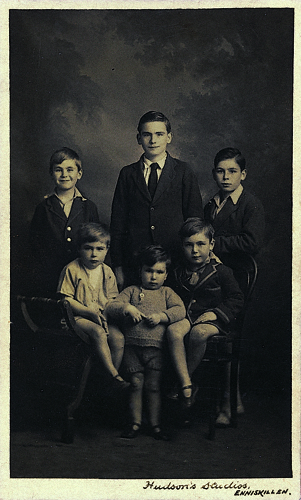
William George Scott was born at 24 Tobago Street, Greenock, in the county of Renfrew, on the southern bank of the Firth of Clyde in Scotland. His father, William John Scott, came from Killymard in Co. Donegal, Ireland; his mother, Agnes Murray, from Glasgow. By the time Scott was born, they already had two daughters, Cathy and Nancy.
1914
4 August
Britain entered the 1914–18 war. Scott’s father volunteered for the army, serving as a driver in the Highland Horse Brigade.
30 October
Scott’s sister Gretta was born. By this date the family had moved to 8 Drumfrochar Road, Greenock.
1915
16 December
Scott’s brother Charles was born.
1918
William John Scott was demobilised from the army and returned home to find his wife working at the flour mills. Agnes Scott and the five children were still living at 8 Drumfrochar Road and Scott was attending the nearby Mearns Street School. William John Scott found work in Greenock as a sign writer, and was employed by barbers’ shops and several ice-cream parlours run by the local Italian community.
1919
20 May
Scott’s sister, Mary, was born.
1921
24 January
Scott’s brother, Hugh Kelly, was born.
1922
30 October
Scott’s brother, John Robert (Bertie) was born.
1924
13 January
Scott’s brother, Alexander Allison, was born.
Due to a lack of work in Greenock, early in the year, William John Scott decided to return to his home town of Enniskillen, leaving his wife to bring the rest of the family at a later date.
June
Agnes and the children caught the steamship from Greenock. After they arrived in Enniskillen, the family stayed at first on Forthill Street with Scott’s paternal grandfather, John Scott, who was working as a cabinet maker. Scott’s father had found work through many of his old school friends painting and decorating their shops and houses in an ornate Victorian style.
1 September
Scott enrolled at the Enniskillen National Model School.
1926
22 February
Scott’s brother, Walter, was born. By this date the Scott family were living at 4 (now 2) Queen Street, Enniskillen.
Scott’s father approached the local art teacher Kathleen Bridle (1897–1989) to ask if his son could attend her art classes. Despite Scott’s young age she agreed to let him join her evening classes at the Enniskillen Technical School as a special pupil. From the start she took a great interest in the young boy. He learned to paint in watercolour and draw from nature at her afternoon classes, and studied life drawing at her evening classes two nights a week. Scott also spent time at Bridle’s home at 8 Townhall Street, looking through her collection of art books. She had been a student at the Royal College of Art in London where she had met, among others, Henry Moore. Knowledgeable about modern art, Bridle introduced her pupil to the work of artists such as Cézanne, Picasso and Modigliani. Scott also recalled learning a great deal by watching Bridle paint his portrait in oils, although she preferred painting outdoors and they would often go out sketching together in the local countryside. Scott knew the area around Enniskillen well and, as a Boy Scout, probably made several outings led by his teacher at the Model school, Robert Scott.
1927
4 November
William John Scott died the day after falling from a ladder while helping to put out a fire at Kirkpatrick Brothers in Church Street, Enniskillen. According to a note found amongst the family papers, he had just started up a building company and had drafted a painted sign announcing, ‘Scott & Sons’.
1928
April
Scott’s sister, Violet Isobel, was born.
May
The Art Inspector for Northern Ireland, John Hunter, informed the Principal of the Technical School that Scott was worthy of recommendation for a scholarship to enable him to continue his studies at a Senior School such as the School of Art in the Belfast College of Technology. That recommendation owed a great deal to Kathleen Bridle, a close friend of John Hunter. The County of Fermanagh Education Committee gave Scott a grant for no more than three years at 25 shillings a week to attend the Belfast School of Art. He stayed at the Presbyterian War Memorial Hostel near the Great Northern Station, which provided accommodation for young Presbyterians working or studying in Belfast. It was in the hostel that Scott met William Tocher, a fellow student who was to become a close friend. Other fellow students included the sculptor Elizabeth Clements (later Betty McCord, and a member of the Ulster Unit), Crawford Mitchell (who became a printmaker and a member of the Ulster Unit), Molly Anderson and Mary Stevenson (later Mary Lark).
Scott made regular visits to the Belfast Art Gallery. As he said later, ‘Being a student in Belfast there was a great advantage in studying a really superb collection of paintings owned by the Ulster Museum [previously the Belfast Art Gallery]. These paintings had been acquired just a few years before I went to Belfast and they provided Tocher and myself with endless discussion.’
1929–30
Scott won a prize of £3 in an open competition promoted by the Belfast Telegraph, and first prize at an Open Design Competition at Dublin.
1930
5 June
Scott’s youngest sister, Violet Isobel, died after a fit of convulsions brought on by whooping cough. She was buried in the same grave as her father.
1931
Scott appears to have failed his final exams at Belfast School of Art. Having discovered that the Royal Academy Schools in London offered free places to talented students, he and Tocher applied and were accepted (Scott had been recommended to the Royal Academy Schools by Ivor Beaumont, Principal of Belfast School of Art from 1919 to 1951).
September
Scott and Tocher left for England and entered the Royal Academy Schools as Probationers for three months. The students received a strict academic training. They spent two days a week (Thursdays and Fridays) copying old masters in the National Gallery and were required to study the writings of Sir Joshua Reynolds and John Ruskin. Only one creative composition was expected each term.
Scott and Tocher quickly became friends with Alfred Janes (1911–99) who had come to the RA Schools from Swansea. Janes was in the Painting School and the three met regularly in the semi-circular drawing studio.
15 December
Having completed his probation period satisfactorily, Scott was admitted to the Royal Academy Sculpture School (headed by the Master, William McMillan). Peter Scott (the naturalist, 1909–89) and the painter Harry Hicken (1911–2000), who was to become a close friend, were admitted at the same time.
Scott spent Christmas in Portsmouth, possibly with the family of George Spencer-Watson, RA (1869–1934), having befriended his daughter, Mary Spencer-Watson (1913–2006), a fellow sculpture student at the RA Schools. The Spencer-Watson family had a house on the Isle of Purbeck, Dorset, not far from Portsmouth. Scott and Tocher would spend several weekends as well as Christmas holidays with the Spencer-Watsons at Dunshay Manor.
1932
Scott visited the exhibition French Art 1200–1900 at the Royal Academy which opened on 4 January (closed 5 March).
June–August
Scott worked his passage home to Ireland for the summer; this was to be a rare visit as the journey was expensive.
December
At the Royal Academy’s annual prize-giving, Scott was awarded a Turner Prize of £15 for a model of a design of a subject combined with architecture. His winning entry was a group of two figures on a pedestal.
Scott spent Christmas in Dorset with the Spencer-Watson family.
1933
Scott spent the term after Easter sharing accommodation with Mervyn Levy (1915–96), then a student at Royal College of Art, at 35 Edith Grove, Chelsea.
May–June
Retrospective Exhibition of Paintings by William Nicholson was held at the Beaux-Arts Gallery, London, from 1 May to 2 June. This major exhibition, which included 84 oil paintings, toured England and Northern Ireland. There is no evidence that Scott saw the exhibition but as an artist sympathetic to tonal painting he is unlikely to have missed the opportunity to see a wide selection of Nicholson’s work.
June
The Spencer-Watsons asked Scott to paint two curtains for their ‘theatre’. Hilda Spencer-Watson (née Gardiner) was a dancer in the manner of Isadora Duncan. She developed a form of dramatic performance, acting out the Greek myths through mime. She put on amateur productions in a theatre in the barn of Dunshay Manor, as well as in a small theatre near Olympia, West Kensington.
August–September
Scott began work on his design for the Gold Medal competition, the subject for which was The Expulsion from Eden. By the end of September, the design was finished and ready to be cast. A photograph of the plaster shows a composition based on Masaccio’s Expulsion (Brancacci Chapel, Santa Maria del Carmine, Florence). A postcard, cut down to show the figures of Adam and Eve, was found amongst the artist’s papers and is a likely source for the plaster.
December
In the annual prize-giving Scott was awarded a Landseer prize of £20 and a silver medal for two models of busts from life.
1934
23 January
Scott transferred at his own request from the Sculpture School to the Painting School (headed by the Keeper, Sir Walter Westley Russell). In a letter to the RA Secretary (Sir Walter R.M. Lamb) Scott explained: ‘I feel that I shall not succeed in doing good work as a Sculptor, and that, as my inclination lies in the direction of painting, I shall make a more satisfactory use of my time by studying in that School.’ Later, however, he maintained that the move had been for practical reasons: ‘One had to be pretty mobile in the early thirties. We changed our digs so frequently that the less gear we had to drag from one place to another the better. Besides, landladies were more tolerant to painters. They were rather against their bedrooms being used as sculptor’s studios. It was simply more convenient to be a painter!’
26 June
Hilda Mary Lucas (1912–99), the daughter of William Temple Lucas and Sybil Wagstaff Thatcher, was admitted as a full-time student to the RA Sculpture School where she met Scott. Known by her middle name, Mary had previously studied at Bristol School of Art and the Slade School. She and Scott met as the latter frequently dropped into the Sculpture School to see his friend Tocher.
July
Scott was awarded a Landseer Painting Scholarship of £40 a year, tenable for two years. He was placed second for Two Painted Figures.
August
Scott returned to Enniskillen, possibly to consult his doctor about problems with his eyes, thought to have been caused by poor nutrition.
November
Scott registered as a copyist at the National Gallery on 12 November. His Referee was Walter Russell, Keeper of the Royal Academy Schools. Copies of two paintings in the National Gallery are recorded: a full-sized version of Piero della Francesca’s Baptism (a work possibly suggested by his teacher Tom Monnington, who greatly admired Piero della Francesca) and a portrait by Van Dyck. A squared-up photograph of the Baptism was found amongst the artist’s papers.
In the same month, Dylan Thomas arrived in London. He shared a room with Alfred Janes at 5 Redcliffe Street, SW10. Mervyn Levy occupied another room in the house. Through Janes Scott met Dylan Thomas and they became firm friends.
1935
Summer
Scott worked on a large canvas, The Adoration of the Shepherds, which he entered for the Gold Medal prize. His grant from Ireland had stopped and he was in need of the £200 prize money. The prize, however, went to John Kingsley Cook (1911-1994).
September
Scott left London for Cornwall, where he stayed in Mousehole in a fisherman’s loft that had been converted into a simple studio by a Cornish friend, Dick Pentreath, the son of a Mousehole fisherman (the loft was most probably Keigwin Studio, the address given for Scott in the 1936 Royal Academy summer exhibition catalogue). There Scott met Laura and Harold Knight, both Royal Academicians. He also met Dod Proctor whose husband Ernest died on 21 October, and whose easel Scott bought for £2.
4 November
Scott wrote to the Secretary of the Royal Academy of Arts to apply for a Lord Leverhume grant, which was awarded to him the following day.
December
Scott officially left the Royal Academy Schools even though his studentship had a year to run. He had been ‘a very satisfactory student in every respect’ according to a reference from the Schools written on 19 October 1939 when he applied for a teaching job in the Republic of Ireland. He was said to have had ‘a very sound training in Sculpture, Drawing and Painting’ and to have ‘attended Lectures in Anatomy, Chemistry and Perspective’.
1936
Scott was still living in Mousehole. (Inscriptions in two books he owned – Georges de Chiricoby Roger Vitrac and Paul Cézanne by Nina Iavorskaia – show that he was in Mousehole in February.)
May
Scott returned from Cornwall to see his Adoration of the Shepherds exhibited at the RA Summer Exhibition. He shared a studio with Mary Lucas at 5 Challoner Mansions in West Kensington.
1937
Mary Lucas won the silver medal awarded by the Edward Stott Architectural Prize for her model of a doorway with two relief sculptures.
19 May
Scott and Mary Lucas were married at Chelsea Registry Office. On the marriage certificate his profession is given as ‘Artist (Painter)’, and his address as ‘The Studio, 62 Lillie Road, Fulham’. Mary Lucas’s profession is given as ‘Sculptress’, and her address as ‘3, Edith Grove, Chelsea’. There were two witnesses: Mary’s mother, Sybil Lucas (who had been given one week’s notice of the wedding), and the painter Robin Pearce. A small reception, attended by close family and friends, was held at the Good Intent (a restaurant in the King’s Road). Later that day, the Scotts arrived in Paris. According to Mary, Scott had secured a small job working on a ‘1937 Paris exhibition’ (very likely a job in the British pavilion of the Exposition Internationale des Arts et Techniques dans la Vie Moderne, which opened on 25 May 1937). The job, small as it was, gave the couple the excuse they needed to get married in order to go to Paris together (her relationship with Scott had been kept secret from her family who, she said, ‘would have been horrified’ if they had known about it). The couple spent a week in Paris, staying at a small hotel in the students’ quarter near St Michel.
July
The Scotts visited Cornwall, staying at a cottage called ‘Hebdey’, at Treknow, near Tintagel. For the next few months, they rented a cottage in Chideock, near Bridport in Dorset, with the use of an old Methodist chapel nearby as a studio. Mary continued to make sculpture and Scott painted a series of portraits of his wife as well as landscapes and still lifes. During the summer they had several visitors including Bernard Hailstone and his wife Joan, and Robin Pearce and his future wife Faye Grant White (also a painter), whose marriage took place that summer in Dorset.
30 December
Learning that the cost of living was cheaper in Italy and France, the Scotts decided to leave England. Before setting out Scott left his recent paintings for safe keeping with Bernard Hailstone who had taken a lease on 2 The Paragon in Blackheath, London, letting out the spare rooms to painters and sculptors at Goldsmiths’ College. The Scotts travelled through France to Alassio, on the Ligurian Riviera where they rented a large, self-contained flat in a villa with a well-kept garden overlooking the sea. From there they visited Florence, seeing the paintings in the Uffizi and the Palazzo Pitti as well as local monasteries. Scott later recalled that he took two books with him, one on Matisse and the other Roger Fry’s Vision and Design. Scott also owned a copy of Fry’s The Arts of Painting and Sculpture, 1932, a text he studied carefully.
1938
January
Mary Scott officially resigned from the RA Schools although her studentship was not due to expire until June 1939.
February–April
The Scotts’ passports record frequent journeys between Italy and France (Alassio is 50 km from the border with France).
9 May
While the Scotts were staying in Florence they witnessed, by chance, Hitler’s official visit to the city.
June
The Scotts decided to move northwards to Brittany where they settled in Pont-Aven. There they met the English artist Geoffrey Nelson, who had studied at the Slade, and the three of them decided to set up a summer art school. According to Scott, Nelson had useful contacts in England and was able to enlist a few supporters. Nelson also persuaded Julia Correlleau, the owner of a local inn, the Hôtel de la Poste, to convert an area at the back of the hotel into a studio on the understanding that the students would stay at the hotel.
Scott met the French painter Maurice Asselin, a former pupil of Walter Sickert. Asselin took a liking to Scott and became a supporter of his work, putting him forward for the British section of the Salon d’Automne in Paris (Scott showed two paintings).
October
At the time of the Munich Pact, which allowed the Nazi annexation of Sudetenland, the Scotts, concerned about the possibility of war, returned to England for a short time.
10 November
The Scotts attended the opening of the Salon d’Automne at the Palais de Chaillot. The couple remained in Paris staying in a residential hostel near Saint Sulpice and spent time in the modern art collection of the nearby Musée du Luxembourg. They then travelled south staying first in a studio right on the harbour in St Tropez; the plan seems to have been to spend the winter months in the south of France.
December
In a letter dated 16 December, M. Laclaverie, the Secretary General of the Société du Salon d’Automne, advised Scott that he had been nominated ‘Membre Sociétaire du Salon d’Automne’.
1939
January
The Scotts moved again in January. Scott’s temporary French identity card (récépissé de demande de carte d’identité) issued at Saint Tropez on 1 January shows that he arrived at Cagnes-sur-mer a few days later where he and Mary stayed at 6 rue St Sebastien.
March
Scott’s identity card shows that he returned to Pont-Aven on 22 March. Meanwhile, plans for the Pont-Aven School of Painting had progressed and a prospectus had been printed.
May
According to the prospectus, the Pont-Aven School of Painting opened at the beginning of May, but it seems likely that the first students only began to arrive in June. Subjects were taught by Scott (Figure and Still Life), Geoffrey Nelson (Landscape) and Mary Scott (Drawing and Sculpture). Maurice Asselin is described as ‘Visitor’. The ‘Supporters’ are listed as Augustus E. John, Sir Muirhead Bone, Walter Richard Sickert and Albert Rutherston. Visits were made to the surrounding fishing villages such as Douarnenez, Tréboul, Trévignon and Port Manec’h, where Scott painted alongside the students. He also had the use of a large studio at the Hôtel de la Poste.
9 June
The Scotts returned briefly to England, a move presumably prompted by the signing of the Pact of Friendship and Alliance between Germany and Italy on 22 May 1939.
29 August
Days before the declaration of war with Germany on 3 September the Scotts left France. They took some of Scott’s paintings with them, rolled up, but others were left for safe keeping in France with Julia Correlleau, together with sketchbooks, sculptures by Mary Scott and personal belongings. Leaving their car on the quay, they caught the boat from St Malo to England where they stayed briefly with Mary’s aunt, Hilda Cleminson (née Thatcher), in Devon.
2 September
The Scotts took the boat from Holyhead to Dublin. They rented a flat at 43 Wellington Road, Ballsbridge, but were unable to find a suitable studio. Over the next few months Scott looked for work as an art teacher (in October he obtained a reference from Tom Monnington RA, his former teacher at the Royal Academy Schools). However, he was turned down on the grounds that he could not speak the Irish language.
1940
5 January
William and Mary’s son, Robert Murray Scott, was born in Dublin.
4 March
Scott registered as an Irish ‘natural-born citizen’.
5 March
The Scotts left Ireland for England where they stayed first with Mary’s family at Clifton, Bristol. Mary’s older sister Marguerite Milton, whose son John was seven years old, agreed to look after Robert while his parents moved to London to work In London, they took a flat in Hogarth Road, Earls Court, and Scott worked in a postal sorting office.
July
Marguerite Milton decided to move to North America with her son John for the duration of the war. It was agreed she would take with her the six-month old Robert Scott. They stayed first in Washington, DC, later moving to Montreal.
After their flat in Earls Court was damaged in an air raid, the Scotts lived briefly with Robin and Faye Pearce in an empty house in Hampstead before moving to Caterham, Kent, with their friends Jo and Deirdre Sloane. The house was owned and built by the sculptor Trevor Tennant (1900–80), and had plenty of space with an orchard and a studio.
Scott exhibited two paintings in London at the Leicester Galleries annual summer show, Artists of Fame and of Promis.
1941
1 March
With financial help from Mary’s family, the Scotts completed their purchase of Elm Tree Cottage and Farm at Hallatrow, Somerset. At first Scott used a room in the house as a studio but later both he and Mary had studios in the outbuildings in the courtyard: the one Scott used was in a long, low building with large French windows and whitewashed walls.
May
Scott took up a part-time teaching post at Bath School of Art, having presented himself to its principal, Clifford Ellis (1907–1985), a well-known graphic designer who became a leading pioneer in post-war art education.
9 July
The Scott’s second son James Michael Scott was born in Wells.
1942
February
The Scotts let Elm Tree Farm to John Partridge for a year and, based in Tintagel, looked for a house to rent in Cornwall.
May
Following the severe damage caused to Bath by the air raids of the weekend of 25–6 April, Bath School of Art was forced to move.
July
One of Scott’s paintings, Girl at a Sewing Machine, was included in Artists Aid Russia, an exhibition which opened at the Wallace Collection, Hertford House, London, on 1 July (closed 4 August). The painting was mentioned (but not identified) by Clive Bell in the New Statesman and Nation: ‘Gallery III opens with an admirable picture by that uneven artist, Matthew Smith; hard by is an interesting experiment by Scott.’
Scott volunteered for the navy but was refused on the grounds that he was ‘too light’ (he was around five feet four inches in height). He served instead in the army, at first in the Royal Army Ordnance Corps. Based in London, he was able to continue painting in his studio at Fernshaw Road, SW10, in his spare time. Mary Scott remained with their son James at Restholme, Polzeath, in north Cornwall.
Scott exhibited at the Leicester Galleries Artists of Fame and of Promise show and received good notices including one by Clive Bell: ‘The art of William Scott is tolerably well known in Paris and deserves to be better known in London.’
12 August
Scott’s brother Hugh was killed on board HMS Indomitable in ‘Operation Pedestal’ off the coast of Malta. Scott returned home to Enniskillen on compassionate leave.
9 September
Scott’s first one-man show opened at the Leger Galleries in Old Bond Street, London, and included 28 oils, the majority of which had been painted in France and brought back to England in the late summer of 1939. The exhibition was arranged by Robert Sielle (1895–1983), a friend who acted as agent for Scott while he was in the army (the name Robert Sielle was a play on his real name, C.L. Roberts). Sielle also ran a successful frame-making business (he had made the frames for William Nicholson’s one-man exhibition at the Leicester Galleries in May 1938). Scott came to rely on him to supply frames for most of his exhibitions.
October
Scott petitioned the War Artists’ Advisory Committee, unsuccessfully, ‘for permission and facilities to paint’.
1943
February
Although Kenneth Clark had been asked to intervene with the army on Scott’s behalf, Scott’s hopes for an appointment as an official war artist came to nothing.
April
Scott exhibited at both the Artists Aid China exhibition at the Wallace Collection and at the Civil Defence Artists exhibition in New Bond Street.
October
Scott was commissioned by Sheila Shannon and W.J. Turner to illustrate Soldiers’ Verse, an anthology of war poems edited by Patric Dickinson. Scott produced 12 lithographs for the book, which was published in 1945 as one of a series of illustrated poetry books. The lithographs were drawn on grained zinc plates and printed by Cowell’s, a well-known firm in Ipswich.
1944
January
Robert Scott returned to England from Canada; up to now Robert and James had been unaware of each other’s existence.
Scott was transferred to Halifax, West Yorkshire. For health reasons he was not sent to Burma with the rest of his unit.
March
No. 2 The Paragon, the house leased by Bernard Hailstone where Scott had left his paintings before leaving for Italy in 1937, was badly damaged in the Blitz after the house next door (No. 1) took a direct hit.
April
Although Scott was officially posted to the map-making section of the Royal Engineers stationed at Wynnstay Hall, Ruabon, in North Wales, on 4 September, a letter to Ruskin Spear dated 23 April shows that he had arrived there some months before: ‘I am still in the army stationed in North Wales, a depressing spot near Chester.’
Conditions at Wynnstay Hall, a large Victorian mansion, were fairly primitive. The owner, Sir Watkin Williams-Wynn (1891–1949), refused to have water pipes laid to the camp, so the soldiers had to be taken in lorries to the mine at Tonypandy to wash, using the same showers as the miners. There was no electric lighting in the main building (Wynnstay Hall) and only low voltage wiring (thought to have been put in by the army during its occupation in the 1940s) in the other parts.
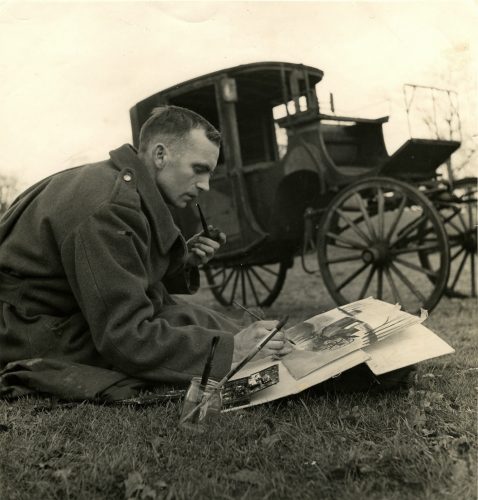
On the assumption that artists made good cartographers, a number of painters and graphic designers, among them Carel Weight (1908–97), Arpad Elfer (1910–99) and Henry Cliffe (1919–83), were stationed at Ruabon over the course of the war. They were allowed time to do their own work and a sketching club was formed. Scott worked in watercolour, painting landscapes as well as a few narrative scenes.
1945
February
A second solo exhibition opened at the Leger Gallery on 3 February (closed 23 February) showing 50 watercolours and drawings.
28 July
Mary Scott’s sister, Marguerite Milton (née Lucas) married Robert Sielle. The Scotts attended the wedding.
August
Scott was represented in the Irish Exhibition of Living Art, which opened at the National College of Art, Kildare Street, Dublin, on 21 August (closed 21 September). Scott had been invited to exhibit by John Piper, and he arranged for the Leger Gallery to lend a watercolour, North Wales.
September
From September 1945 to January 1946 Scott, now promoted to Sergeant in the Army Education Corps, worked as an Art Instructor under the Army Education Scheme (at the Survey Training Centre, Royal Engineers, Longleat Camp, Warminster). Longleat Camp was near enough to Hallatrow for Scott, who had the use of a car, to be able to spend some nights at home at Elm Tree Farm.
December
Mary and William Scott had a joint show of watercolours at the Leger Gallery.
Scott visited the Exhibition of Paintings by Picasso and Matisse organised by L’Association Française d’Action Artistique and the British Council at the Victoria and Albert Museum, London. The trip was one of a number of cultural expeditions organised by the Army Education Corps.
1946
January
After a long delay Scott was finally demobilised from the army. Scott evidently found it hard to adjust to his new circumstances, however.
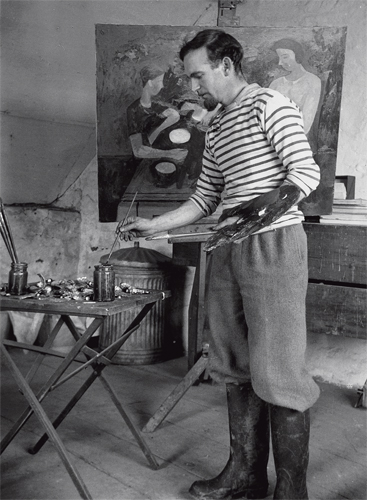
The Scotts continued to live at Elm Tree Farm, growing their own vegetables and keeping livestock. Scott’s studio was at this time above the garage.
Felix and Julian Salmon (the Lyons directors with responsibility for the teashops) commissioned a series of lithographs by 16 British artists to make ‘the surroundings of the teashops more attractive’. Scott, along with Ruskin Spear, Edward Ardizzone, Edward Bawden, Duncan Grant and L.S. Lowry, designed and lithographed their own prints which went on display in Lyons teashops in October the following year. Scott became involved in the scheme through Clifford and Rosemary Ellis who also contributed to the series.
April
The Tate Gallery partially reopened. The exhibition Braque and Rouault opened there the same month (closed May).
16 September
The Scotts returned to Pont-Aven briefly to recover the paintings and possessions they had left behind in 1939, but were told by their former landlady Julia Correlleau that everything had been taken by the Germans who had requisitioned the Hôtel de la Poste during the Occupation.
Autumn
Scott was appointed Senior Painting Master at the Bath Academy of Art, now housed at Corsham Court in Wiltshire, the ancestral home of Lord Methuen. Mary Scott was given a post teaching sculpture. The school got underway in the autumn of 1946. Initially, Scott taught the Ministry of Education National Diploma in Design course, but, in 1948, he stopped doing so as the Senior Ministry Inspector for Higher Education Establishments, Mr E.M.O’R. Dickey, advised the Principal, Clifford Ellis, that Scott’s teaching methods were ‘unacademic’ and far too adventurous. As head of the painting department Scott recruited such new teachers as Peter Lanyon, Bryan Wynter and Terry Frost. The printmaker Henry Cliffe, who had met Scott when they were both stationed at Ruabon in 1944, enrolled as a student in 1946, joining the staff in 1950.
One of the more notable students at Corsham was Marie-Christine Trienen, a young French student, who probably arrived at Bath Academy of Art in 1951. Knowledgeable about the work of Jean Dubuffet and art brut, and working in a highly individual style in painting, sculpture, print-making and pottery, she exerted a considerable influence on many of the staff at Corsham, in particular Kenneth Armitage and Scott.
Seven paintings by Scott were included in the exhibition Four Young British Painters, organised by the Arts Council of Great Britain, which toured in the UK.
Frederick Muller asked Scott to illustrate a new edition of Jane Eyre. Owing to government paper restrictions, the book was never printed although the drawings were lithographed and proofed. (In 1949, proofs of the Jane Eyre illustrations were exhibited at the Arts Council exhibition Classics of Literature Illustrated by Contemporary Artists. An Exhibition of Drawings, Lithographs and Engravings.)
1947
Early in the year, the Hanover Gallery, run by Erica Brausen (1908–92), opened at 32a St George Street, just off Hanover Square, in London. Brausen, who was born into a conservative merchant bourgeois family in Düsseldorf, began her career in London at the Redfern Gallery, 20 Cork Street. The Hanover was one of the few London galleries to maintain close contacts with European artists and galleries. Erica Brausen was also interested in new artists: one of the younger painters she took on was Francis Bacon who had his first one-man show at the Hanover Gallery.
March
The Cubist Spirit in its Time opened at the London Gallery on 18 March (closed 3 May). The exhibition was organised by the Belgian-born dealer and collagist E.L.T. Mesens who also compiled the catalogue with the help of Robert Melville.
Scott’s Girl on Beach, 1939 was reproduced in colour in The Penguin New Writing.
August
Several works by Scott were included in the British Council exhibition, Modern British Paintings (1942–1947), which toured Europe. A letter to the artist from the British Council dated 16 May 1947 sets out the plans for the exhibition of roughly 50 paintings by contemporary British artists ‘for exhibition in France, Czechoslovakia, Greece and Austria’. The idea was to represent ‘the more advanced aspects of contemporary British painting’.
1948
August
The Scotts stayed in St Ives, Cornwall. There Scott met Patrick Heron (1920–99.)
October
Scott had his first one-man show at the Leicester Galleries in London (30 paintings, mostly still lifes and nudes).
November–December
The Scotts spent over a month travelling in Italy and the south of France. Postcards sent to their son James between 4 November and 15 December show that the Scotts arrived in Rome on 4 November ‘after two days on the train’. By the end of the month they were in Florence, followed by visits to Genoa, Nice and Monte Carlo. While in Rome, they met the Italian painter Renato Guttuso (1911–87).
1949
Spring
Scott designed the cover of the Spring Book Number of the Listener.
April
The publisher John Lehmann turned down Scott’s illustrations for Jane Eyre. In a letter dated 27 April, Lehmann wrote: ‘I looked at your illustrations of Jane Eyre with great interest and fascination, but I am afraid I don’t really feel we could undertake to do an edition. The plates are rather a difficult size for one thing; and for another Jane Eyre does, alas, appear in a number of editions both old and new.’
Peter (Piotr) Potworowski (1898–1962), a Polish émigré, was invited by Clifford Ellis to join the staff at Bath Academy of Art.
September
The Scotts sold the part of the property at Hallatrow known as Elm Tree Farm but continued to live at Elm Tree Cottage. They kept the studio outbuildings and later extended the cottage.
October
Scott spent about a month working at Peter (Piotr) Potworowski’s London studio in St John’s Wood.
Scott was elected a member of the London Group, an exhibiting society founded in 1913. Ruskin Spear had been elected President in 1948 and the following year he oversaw the election of a number of new members including F.E. McWilliam, who was to become a close friend of Scott, and Peter (Piotr) Potworowski.
1950
January
From Gainsborough to Hitchens: A Selection of Paintings and Drawings from the Howard Bliss Collection opened at the Leicester Galleries on 5 January (closed 2 February). Howard Bliss was an important collector of Scott’s paintings, seven of which were included in the show.
March
The Private Collector: An Exhibition of Pictures and Sculpture Selected from the Members of the Contemporary Society’s Own Collections opened at the Tate Gallery on 23 March (closed 23 April). Two collectors showed paintings by Scott: Raymond Mortimer and Elizabeth Watt.
May
Ten works by Scott were included in Painters’ Progress, an exhibition organised by John Rothenstein which opened at the Whitechapel Art Gallery on 11 May (closed 15 July). John Rothenstein was then Director of the Tate Gallery and this exhibition was one of the many ways in which he demonstrated his commitment to modern British art. His theme was the development of ten contemporary artists, beginning with Duncan Grant as the most senior and ending with Prunella Clough, then aged 31 (the other artists were L.S. Lowry, Anthony Levett-Prinsep, Ivon Hitchens, Keith Vaughan, John Armstrong, John Piper and John Napper). The artists were asked to choose pictures covering their whole careers including some of their earliest and latest works.
July
The Scott family travelled to Pont-Aven where they spent the summer. It was a camping trip and they pitched their Bell Tent in a field outside the town. Scott took with him a painting to give to Julia Correlleau in order that he could be represented in the Hôtel de la Poste collection.
Scott was invited by the Arts Council of Great Britain to paint a large picture, no less than 45 x 60 inches (114.3 x 152.4 cm), for the exhibition Sixty Paintings for ’51, which formed part of the 1951 Festival of Britain. The painting, Still Life, 1951, which the artist considered to be a culminating point in his long series of frying-pan pictures, presented a considerable challenge.
During the course of 1950 Scott met several artists who were to become close friends. The sculptor F.E. McWilliam (1909–92), then working on large sculptures for the Festival of Britain, was one, Louis le Brocquy (b. 1916) another. Le Brocquy had arrived from Dublin and Scott introduced him to McWilliam. A third was Paul Feiler (b. 1918): Scott approached Feiler in the artist supplies shop Barton & Long in Clifton, Bristol, and asked if he could visit his studio.’
1951
13 January
L’Ecole de Paris 1900–1950 opened at the Royal Academy. In his copy of the catalogue Scott put a pencil mark against the following paintings: Braque’s The Studio, 1949; Miró’s Femme, Etoiles, 1945; Alfred Manessier’s Espace Matinal, 1949.
February
Scott’s second one-man show opened at the Leicester Galleries on 1 February (closed 22 February). The exhibition attracted a number of reviews, mostly positive. The week after the exhibition opened the Scotts visited the artist’s mother in Enniskillen.
10 February
The only self-portrait made by the artist was published on the front page of the February issue of Art News & Review, a London fortnightly produced in a newspaper format. (The editor of Art News & Review, Bernard Denvir, had developed a format for showcasing relatively new artists by reproducing their self-portraits on the front page of the magazine.)
April
Scott was included in the exhibition 21 Modern British Painters, organised by the British Council, which toured Canada and the United States. According to a press cutting found amongst the artist’s papers, he was represented also in the Belfast Art Gallery’s show of contemporary painting.
May
Scott was included in Sixty Paintings for ’51, a touring exhibition organised by the Arts Council of Great Britain as part of the Festival of Britain. It opened at Manchester City Art Gallery on 2 May (the tour ended in June 1952). The artists who contributed to the exhibition were chosen from an initial list of 145 names. As it turned out, 54 artists were represented after some either refused the invitation or subsequently withdrew, or else were prevented at the last minute from submitting their canvases. In June, the exhibition was shown at the R.B.A. Galleries, Suffolk Street, London, and subsequently at the art galleries in Leicester, Liverpool, Bristol, Norwich, Plymouth, Leeds, Newcastle, Brighton, York and Preston. The exhibition was devised by Philip James with the aim of encouraging corporate patronage of the visual arts.
July
Scott supplied pictures for the Exhibition of Architecture for the Public at Castle Street, Belfast. Exhibitors include members of the Royal Society of Ulster Architects (RSUA) Exhibition Design Group.
August
The Scotts stayed in Cornwall, at Nile Studio, Sennen.
October
Scott visited Paris.
November
Scott exhibited two unidentified abstract paintings at the annual London Group exhibition.